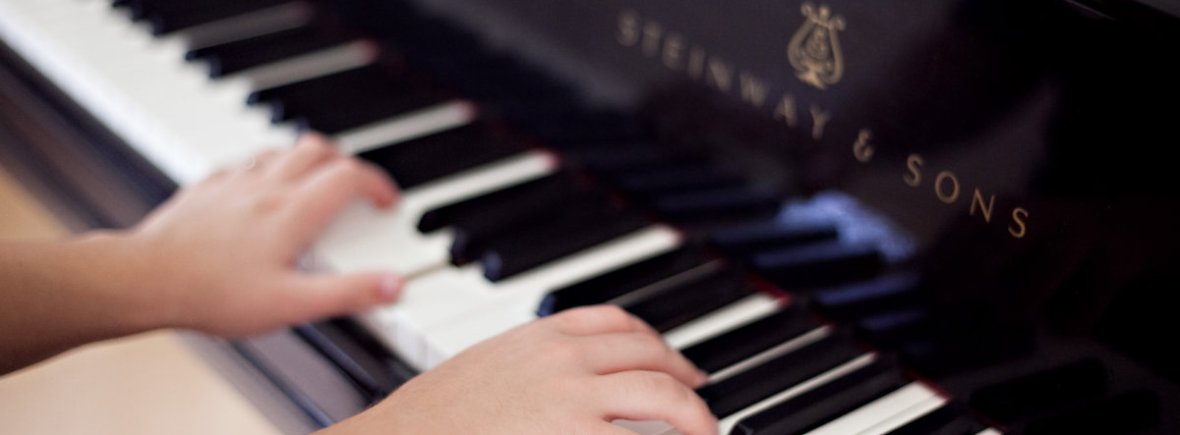
Portzline Music Academy specializes in whole-brain and whole-body music experiences for your child. Our program recognizes that music is a language, and that a child develops musical skills in a similar way to the way they learn their primary language; first by hearing and experiencing, then by listening with understanding and “hearing” the language inside their mind (the term for this is “audiation”), then by speaking, and then by writing and reading. At our studio, the imitation of musical patterns by chanting poetry, singing, and playing simple instruments begins the pathway to musical literacy, and is facilitated by home and family activities, particularly from birth through age 9. Our studio uses Musikgarten’s curriculum for ages 4-9 years because it approaches music as a language and nutures a child’s ability to obtain piano skills in a holisitic and musical way from the very beginning.
When music and movement are a natural, joyous part of childhood, children benefit greatly in many areas of life. Language development, self expression, memory skills, concentration, social interaction, fine motor skills, listening, problem solving, teamwork, goal setting, and coordination are all impacted by early music and movement education. What’s more, as a child learns to play music, other areas of development — creativity, family bonding, self-esteem, confidence, emotional development — are also positively impacted.
Children 0-5 years old have the opportunity to begin their musical language adventures at the local library in our Sing & Play for Toddlers class. This class is focused on a toddler’s development and adapted to include ages newborn to 5 years attending with their parent or caregiver. It is designed to increase a child’s overall musical, language, thinking and motor skills, including auditory skills and impulse control, by singing, tapping, playing simple instruments, pretend play, and simple movement activities. The classes are meant to facilitate the continuation of these types of activities at home and with the child’s family, and are currently being offered as a community service outreach at no cost. For class dates, unit topics, and registration, go to Toddler Class Registration.
Children 4-6 years old are ready for the next step to music literacy in a small music class, Music Makers at Home in the World (MMH), that builds on this nurturing and exploratory foundation with units that explore the world of nature and its sounds. This is combined with learning folk songs, playing singing games, simple instruments, and learning the sounds of specific orchestral instruments. Students also begin learning aural and visual music patterns. Music CDs (or downloads) and cards are used at home. The units for this program are My Home Place, Woodlands, Marsh, Meadow, & Seashore.
Children 6-8 years old are ready to learn beginning piano skills. Students have the opportunity to begin with a 6-week Introduction to the Piano in the summer with a weekly 75-minute class of 3-4 students. This gives students the chance to try out their interest and readiness for learning to play the piano. During the school year, two semesters of Musikgarten’s Music Makers at the Keyboard program are offered, using the same 75-minute, small class setting. Enrollment for this program may be limited.
In the Music Makers at the Keyboard (MMK) class, piano students practice the fine motor skills for playing simple melodies and chords at the piano. In addition to playing the piano, the children also play singing games, dance, write, play drums & resonator bars. This is combined with card games that teach children to audiate and visually recognize written melodic and rhythmic patterns, to vocalize and play melodic and rhythmic patterns at the piano, and to hear musical forms.
MMK students who graduate from Books 1 & 2, or who are at a similar level of musical and motor skills, may continue their piano learning in Trio Classes or Partner Lessons, which always include one-on-one instruction. Private Piano Lessons may be chosen as needed, and are most helpful after the musical literacy foundation is in place.
The decision to have private lessons, as well as the private lesson length, is made according to each student’s need for more individual instruction and/or the student’s desire to practice the piano more, progress more quickly, learn how to improvise and compose, learn music theory, and to experience more difficult and lengthier piano repertoire.
75-minute lessons for two with students alternating between one-on-one teacher instruction and individual work at a keyboard, helps students have more than a half hour lesson at a more practical cost, by sharing 15 minutes at a discount. This can work really well for siblings or friends. The piano tuition page shows all options and cost.
Upper Intermediate and Advanced students may choose partner lessons at any time to work on two-piano duets. Ensemble playing is a great boost for musical skill development and can work well for siblings or friends at similar playing levels. Individual time for solo music is always included as part of each lesson.
 Portzline Music Academy